Guide available
In this guide
Medical preparation
- Share all medical conditions, allergies, previous operations, medicines and supplements.
- Report dry eye, persistent tearing, glaucoma, retinal disease, thyroid eye disease, double vision, reduced vision, previous LASIK or cataract surgery, and contact-lens use.
- Tell your doctor about aspirin, warfarin, clopidogrel and other anticoagulants. Never stop prescribed medicine on your own.
- Diabetes, blood pressure and other conditions should be controlled as well as possible. Stop smoking, vaping and nicotine according to the surgeon's plan.
- Perfect symmetry or invisible scars cannot be guaranteed; standard photographs are taken before surgery.
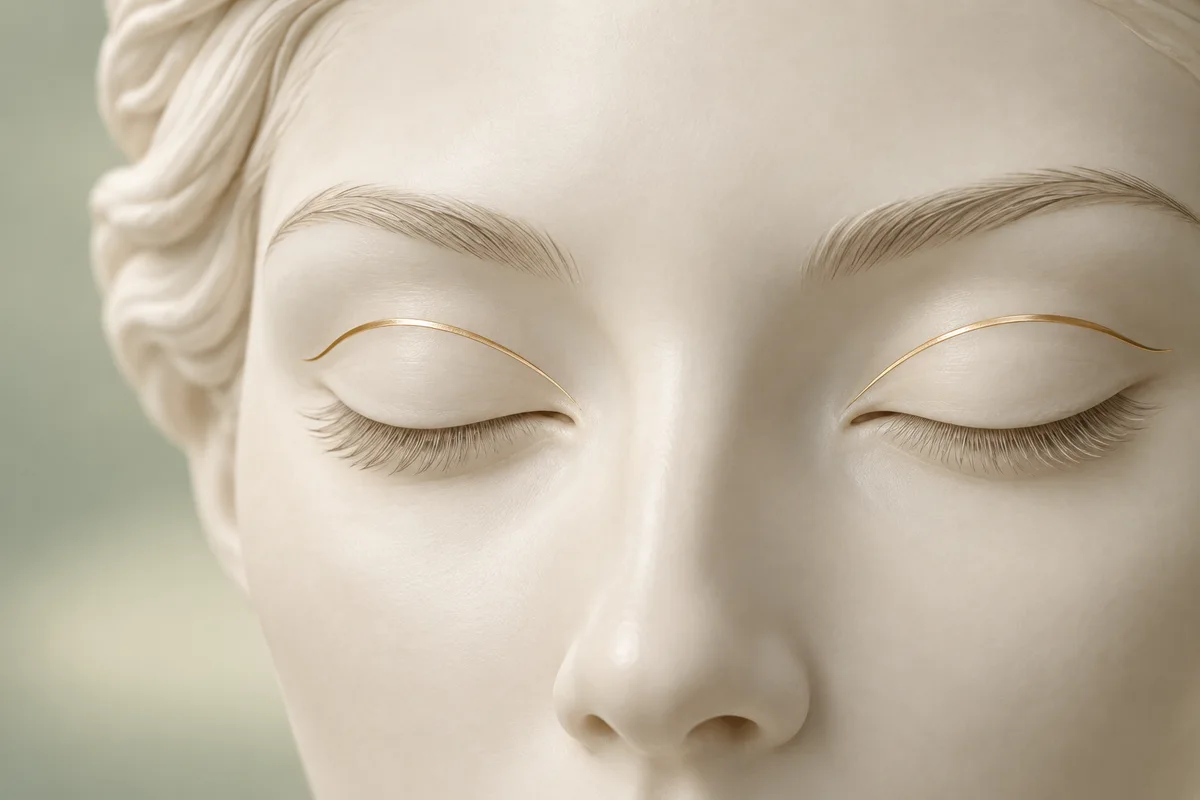
Upper eyelid contour concept
AI-created conceptual artwork; not a patient result or an exact surgical diagram.
Explore the educational diagram and sources
Educational illustration
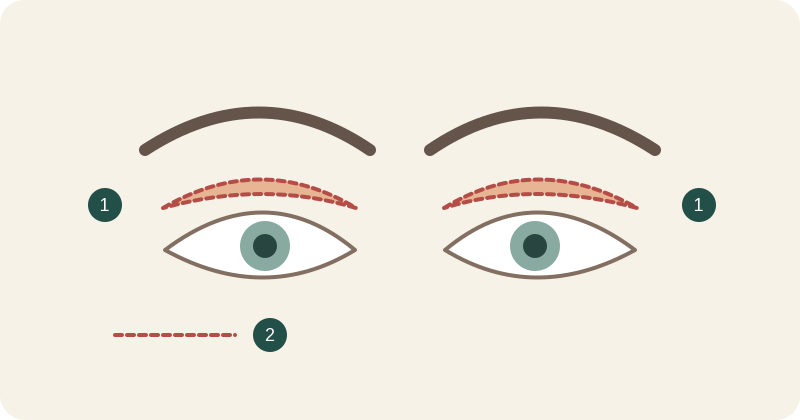
Upper eyelid surgery: 1 example of an excess-skin marking above the natural eyelid crease; 2 dashed red line denotes an incision marking. The extent is individualized; the diagram does not show lower-eyelid surgery.
An educational schematic, not a patient result or a personalized treatment plan. Original labels may be in another language.
Open larger image ↗Source & licence
Original Taharaz educational schematic; clinical reference linked below
Procedure concept — clinical reference · Original illustration
Simplified educational image; not to scale.
The night before and surgery day
- Follow the surgeon's and anaesthetist's exact fasting instructions and take only medicines approved for that morning.
- Arrive with a clean face and no eye make-up, cream, false eyelashes, contact lenses, jewellery or nail polish.
- Wear comfortable front-opening clothes.
- Arrange an adult escort home and do not drive yourself. Bring your medicine list and glasses.
The first 48 hours
- Swelling, bruising, tightness, watering, mild dryness or irritation, and temporary blurred vision can be expected.
- Rest and sleep on your back with the head elevated on two or three pillows.
- If advised, use a cold compress without pressure and with a cloth barrier; never place ice directly on the skin.
- Use ointment, eye drops, artificial tears, antibiotics and pain medicine only as prescribed. Ointment and swelling can temporarily blur vision.
- Keep wounds and tapes clean and dry as instructed; do not rub the eyes or disturb stitches.
Activities and restrictions
- Do not drive until your vision is clear and your doctor has approved it.
- For one to two weeks avoid prolonged bending, straining, heavy lifting, strenuous exercise and swimming.
- Avoid eye make-up until wounds have healed. Contact lenses are commonly avoided for one to two weeks; wear glasses instead.
- Avoid sauna, steam, very hot baths and hot tubs until approved, and wear sunglasses outdoors.
Stitches and normal recovery
- Suture removal depends on the technique and is commonly planned at about 5–10 days.
- Swelling and bruising may peak during the first 2–3 days and then improve. Most bruising settles within 1–2 weeks, but lower-lid recovery may take longer.
- Dryness, light sensitivity, watering, numbness or temporary difficulty closing the eyes may occur.
- Early asymmetry is common; do not judge the final result in the first days.
- Scars initially look pink or firm and soften and fade over several months; final contour may also take months.
Follow-up
- The first review is usually arranged within the first few days according to the surgeon's plan.
- A further appointment is arranged for wound review and suture removal.
- Photographs and results are commonly reviewed during the following weeks and again at 2–3 months.
Urgent warning signs
- Sudden loss of vision, progressively blurred vision or any significant visual deterioration.
- Severe or increasing pain in or behind the eye, or sudden one-sided tense swelling or pressure.
- Eye protrusion, difficulty moving the eye or severe new double vision.
- Continuing bleeding, marked inability to close the eye with severe dryness or pain, spreading redness, pus or fever above 38°C.
- Severe nausea or headache with eye pain or visual change. Do not wait for the next appointment if these occur.
Was this guide helpful?
Your feedback helps us improve this guide.