Guide available
In this guide
What breast augmentation can—and cannot—do
- A breast implant is a medical device used to add volume, correct selected asymmetry or reconstruct a breast. This guide covers cosmetic augmentation; reconstruction after cancer needs a separate plan.
- An implant alone does not correct substantial drooping. A lift may also be needed. Fat transfer can offer a smaller increase for suitable patients, with variable retention. Perfect symmetry, invisible scars and a particular result cannot be guaranteed.
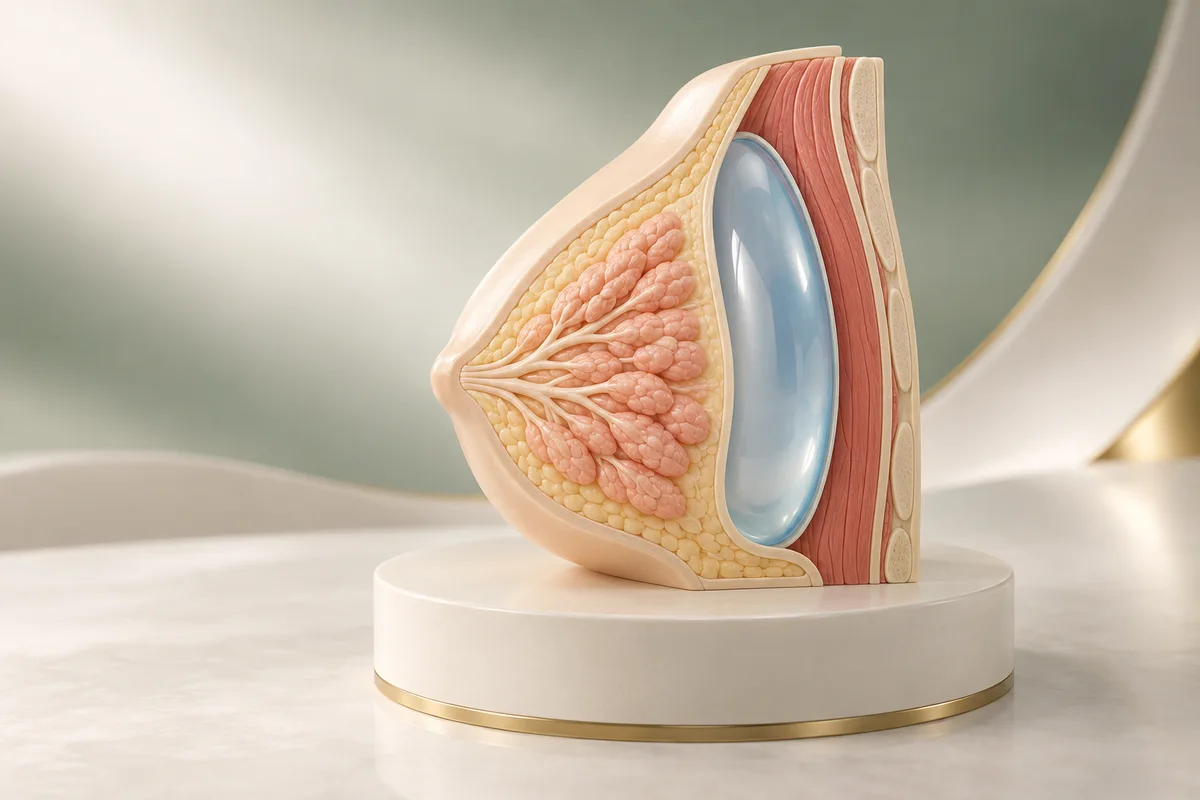
Breast implant placement concept
AI-created conceptual artwork; not a patient result or an exact surgical diagram.
Explore the educational diagram and sources
Educational illustration
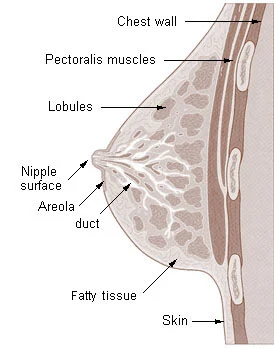
Breast cross-section: glandular tissue, ducts, fat and the underlying chest muscle.
An educational schematic, not a patient result or a personalized treatment plan. Original labels may be in another language.
Open larger image ↗Source & licence
National Cancer Institute / NIH (SEER)
Illu breast anatomy.jpg · Public domain
Simplified educational image; not to scale.
Saline, silicone and cohesive gel
- Saline implants have a silicone shell filled with sterile salt water; rupture usually causes visible deflation. Silicone gel often feels more natural, but rupture can be silent.
- More cohesive or “gummy bear” gels are still silicone implants and do not eliminate rupture or repeat surgery. Approval, minimum age and availability differ by country and product; brand alone should not determine selection.
Round or anatomical; smooth or textured
- Round and anatomical/teardrop implants differ in shape. Rotation of an anatomical device can alter the breast contour. A natural appearance also depends on tissue, dimensions and placement.
- BIA-ALCL is associated more often with textured implants. Ask about the exact surface, local approval, recalls and why that model is proposed. No surface is risk-free.
Size, profile and placement
- Volume in cc, base width and projection must fit chest dimensions, tissue coverage, skin and goals. Bra cup sizes are not standardized; larger is not automatically better.
- Placement may be above muscle under breast tissue, under fascia in selected cases, submuscular or dual-plane. Coverage, visible edges, early discomfort and movement with muscle contraction differ. Examination guides the choice.
Incisions and a possible lift
- An inframammary incision is common; periareolar or axillary access may suit selected cases. Discuss scars, access, nipple sensation and breastfeeding.
- Excess skin or drooping may require a simultaneous or staged lift, with additional scars. Reduction, lift and augmentation are different procedures.
Assessment before surgery
- Report prior surgery, breast symptoms, family cancer history, allergies, all conditions, medicines and supplements. Examination, age/risk-appropriate breast imaging, tests and anaesthetic assessment are individualized.
- Active infection, uncontrolled illness, pregnancy or breastfeeding can change timing. Discuss future pregnancy and major weight changes; a new lump must be assessed before cosmetic surgery.
Preparation and surgery day
- Agree a smoking, vaping and nicotine cessation plan. Disclose blood thinners, diabetes and weight-management medicines; do not stop or substitute prescribed medicine yourself.
- Follow anaesthetic fasting and medicine instructions. Arrange front-opening clothes, an adult escort and first-night support. Review consent and product-specific information beforehand; obtain your implant identification card afterward.
Early recovery: pain, dressings and support
- Pressure, manageable pain, bruising, swelling and temporary asymmetry may occur, but should improve. Use medicines only as prescribed. Sudden one-sided swelling or severe increasing pain requires assessment.
- Support-bra type/duration, showers and dressings depend on the operation. Leave tapes and wounds alone; avoid soaking and swimming until cleared. If a drain is used, learn its care and how to record output.
Sleep, movement, work and exercise
- Short regular walks usually start early. Follow advice on sleeping position and arm movement; back sleeping and avoiding pressure are commonly advised initially. Prolonged bed rest is not appropriate.
- Light work may be possible after about one to two weeks. Heavy lifting and strenuous/chest exercise are often restricted for roughly four to six weeks, sometimes longer; clearance is individual. Do not drive while sedated or unable to control the vehicle fully.
Massage, scars and everyday care
- Massage is not appropriate for every implant or technique; do it only when specifically instructed. Pressure, exercise and creams do not replace assessment of displacement or firmness.
- Use silicone scar gel/sheets only after full wound closure and approval. Protect scars from sun. Final settling and softening may take several months.
Complications and limitations
- Risks include bleeding, infection, fluid collections, poor healing, altered sensation, persistent pain, asymmetry, rippling, displacement, rotation, rupture and capsular contracture. A tight capsule can cause firmness, distortion and pain, sometimes requiring surgery.
- BIA-ALCL is an implant-associated lymphoma, not ordinary breast cancer, and is more closely associated with textured devices. Rare squamous-cell carcinoma and other lymphomas have also been reported in capsules. Late swelling, a mass or new pain needs assessment.
- Some patients report fatigue, joint pain or concentration problems, sometimes called BII. Their causes and precise relationship to implants remain uncertain. Other causes need evaluation; improvement after removal is not guaranteed.
Long-term checks and replacement
- Implants are not lifetime devices, but routine replacement of every implant at ten years is not a universal rule. Symptoms, examination, imaging and the product guide decisions. Further surgery may be needed.
- For asymptomatic silicone implants, FDA guidance recommends a first ultrasound or MRI at five to six years, then every two to three years. This is US guidance; agree a local personal plan. New symptoms require earlier review. Keep your model, surface, serial number, implant card and operation report.
Mammography, pregnancy and breastfeeding
- Continue breast-cancer screening according to age and risk. Tell the imaging centre about implants before mammography so appropriate views can be obtained. Implant-integrity scans do not replace cancer screening.
- Breastfeeding is possible for many people but cannot be guaranteed; anatomy and technique matter. Pregnancy and weight changes can alter shape. Discuss timing and the possibility of a future lift.
Questions for the consultation
- Why this model, surface, size and pocket? Is a lift needed? What are the surgeon’s qualifications and facility arrangements? What follow-up, complication and revision costs should I anticipate?
- Obtain written review dates, out-of-hours contact, travel/flight advice, work/exercise restrictions and imaging plans. Arrange local follow-up before travelling home after medical tourism.
Warning signs needing prompt help
- Breathlessness, chest pain, fainting or a painful swollen calf require emergency care; call 112 in Türkiye. Rapid tense swelling of one breast, active bleeding or severe increasing pain needs urgent surgical assessment.
- Report fever, spreading redness, pus, wound opening or exposed implant the same day. New persistent swelling, a lump, shape change or pain months or years later also needs prompt investigation.
Sources
Was this guide helpful?
Your feedback helps us improve this guide.