Guide available
In this guide
Warning signs: get urgent help
- Sudden unexplained breathlessness, new chest pain (especially on breathing in), coughing blood, fainting or a very fast heartbeat may signal PE. After surgery in particular, do not wait for WhatsApp or your next appointment: call 112 in Türkiye or your local emergency number. Do not drive yourself.
- New swelling, pain, warmth or redness in one leg needs urgent same-day assessment. With chest pain or breathlessness, treat it as an emergency. Normal home oxygen readings or no leg swelling do not exclude PE.
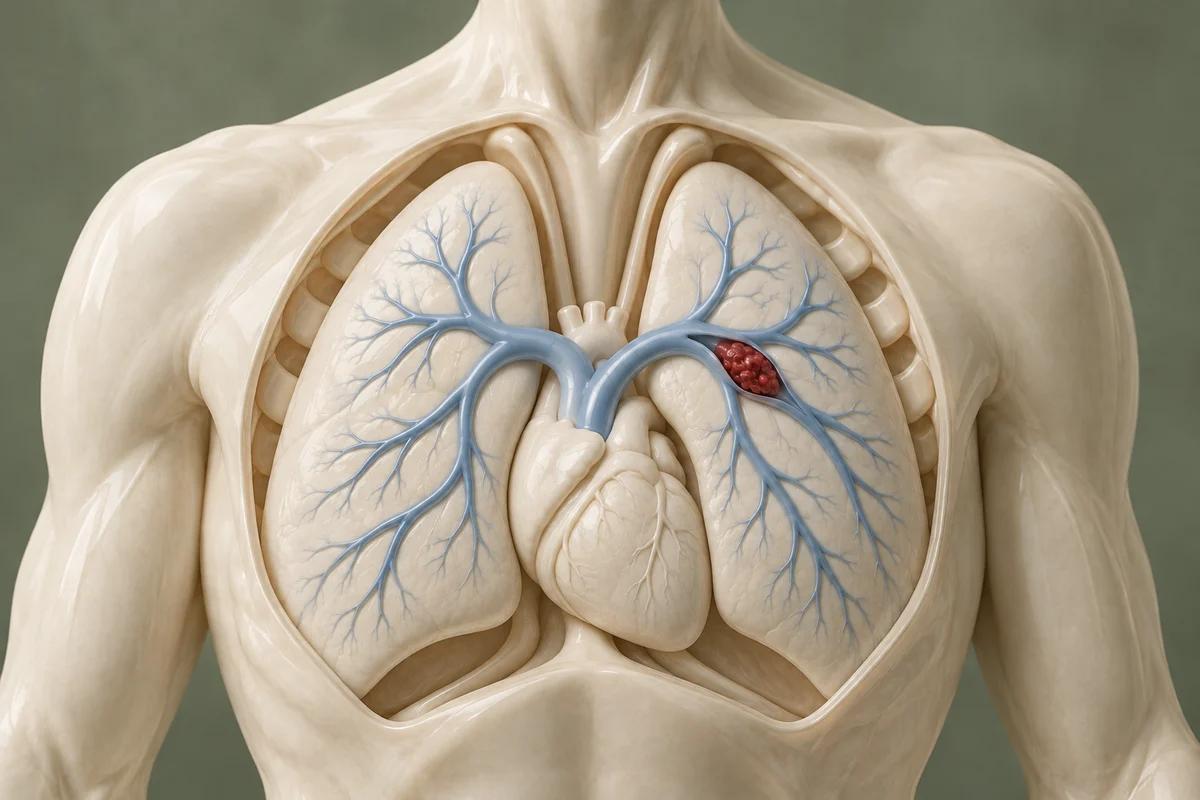
Pulmonary embolism concept: a clot in a lung blood vessel, not an airway
AI-created conceptual artwork; not a patient result or an exact surgical diagram.
What is pulmonary embolism?
- PE usually occurs when a blood clot from a deep leg or pelvic vein (DVT) travels through the right heart and blocks a pulmonary artery. DVT and PE together are called venous thromboembolism (VTE).
- This blocks blood flow, not the airway. It can impair oxygen exchange and strain the right heart; severe PE can be life-threatening. Prompt assessment matters.
How likely is it?
- Risk varies with the operation, immobility, health conditions, previous clots and prevention. A statistic for VTE includes DVT and must not be presented as PE alone.
- MBSAQIP 2023 cohort, 200,865 operations: 30-day PE was 0.10% after sleeve and 0.12% after Roux-en-Y bypass (10 and 12 per 10,000). Source: PMID 40889062.
- These are study figures, not this clinic’s results or your personal prediction. They do not apply to every cosmetic procedure or operation. Both clotting and bleeding risks require individual assessment.
Who is at higher risk?
- Previous DVT/PE, known clotting disorders, family history, active cancer, older age, obesity and certain heart or inflammatory diseases increase risk.
- Major or prolonged surgery, hospitalisation, limited mobility, trauma and long journeys during recovery matter. Pregnancy, the postpartum period and oestrogen-containing medicines also matter. Tell the team about all factors; do not change medicines yourself.
Risk after discharge
- Clots can occur days or weeks after surgery, including at home. The duration of risk depends on recovery and mobility. Feeling well, keyhole surgery or early discharge does not mean zero risk.
- Act on new warning symptoms even after finishing preventive medication.
Before surgery
- Disclose clotting and bleeding history, kidney disease, cancer, pregnancy, all medicines and supplements, and travel plans. Ask for a personal prevention plan.
- Clinicians may use a validated score such as Caprini alongside clinical judgement; it is not a self-diagnosis tool. Discuss smoking, mobility and any adjustment of hormones or anticoagulants in advance.
Prevention in hospital and at home
- Once permitted, take short frequent walks and move your ankles and toes while resting. Avoid long periods without movement. Breathing exercises do not replace clot prevention.
- Follow your postoperative fluid plan and any heart/kidney restrictions. Hydration alone does not replace prescribed medication or movement.
- Use fitted anti-embolism stockings or intermittent compression only as advised. Report pain, numbness, colour changes or skin injury. Some arterial and skin conditions make them unsuitable. Prevention reduces risk; it cannot eliminate it.
Anticoagulant safety
- The medicine, timing and duration depend on clotting versus bleeding risk, weight, kidneys, operation and anaesthesia. This guide does not prescribe a dose. Some patients need treatment after discharge.
- Follow the written stop date; do not stop early because you feel well. Ask a pharmacist or clinician about a missed dose rather than doubling it. Aspirin is not an automatic substitute. Check painkillers and supplements for interactions.
- Uncontrolled bleeding, vomiting blood, black stools or a new severe headache, particularly after head injury, need urgent assessment. Promptly report blood in urine or unusual bruising.
Flights and long journeys
- There is no single safe postoperative flight date. Obtain individual clearance and written advice before travelling. Keep medicines and records accessible.
- For journeys over four hours, move the ankles frequently and, when allowed and safe, walk or stop about every one to two hours. Extra stockings or medication need individual advice; do not self-start aspirin. New breathlessness, chest pain or suspected DVT means urgent assessment before travel.
Diagnosis
- Clinical assessment may lead to CT pulmonary angiography, leg ultrasound or a ventilation–perfusion scan. Tests depend on your history and clinical probability.
- D-dimer may help exclude clots in selected patients, but surgery can raise it without PE. It cannot diagnose PE on its own. Normal home oxygen, ECG or chest X-ray cannot reliably rule it out.
Treatment and recovery
- Anticoagulants prevent clot growth and new clots while the body gradually clears them. Confirmed PE usually needs at least three months of treatment, unlike short postoperative prevention; duration is individual.
- Severe unstable PE may require clot-dissolving medicine, catheter treatment or surgery. Recent surgery and bleeding risk affect these decisions. Vena cava filters are for selected situations, not routine prevention.
- Attend follow-up. Persistent breathlessness or exercise limitation needs assessment for complications, including uncommon chronic pulmonary hypertension. New or worsening symptoms require urgent review.
Fat embolism, common questions and discharge checklist
- Fat embolism is different from a blood-clot PE and can follow certain injuries or fat-related procedures. Standard anticoagulants do not guarantee its prevention. New respiratory symptoms after any procedure need urgent assessment.
- Can PE occur without leg pain? Yes. Do walking and injections remove all risk? No. Is a home oximeter enough to exclude it? No.
- Before discharge, confirm medicine name, schedule and stop date; missed-dose advice; mobility limits; travel clearance; follow-up and emergency contacts.
- Educational information compiled 10 October 2026. Your individual assessment, prescription and discharge instructions take priority. Sources below.
Sources
- NHS — Pulmonary embolism
- NICE NG89 — Preventing hospital-associated VTE
- CDC — Risk factors for blood clots
- CDC — Blood clots and travel
- NHLBI — Diagnosis
- NHLBI — Treatment
- NHLBI — Recovery
- MBSAQIP 2023 cohort — 30-day pulmonary embolism after sleeve and Roux-en-Y bypass (PMID 40889062)
- ESC — Acute pulmonary embolism guideline
- Fat embolism syndrome — BJA Education review (2021)
Was this guide helpful?
Your feedback helps us improve this guide.